Night Vision
Photo by Jacob Yoder
Night Vision
by Steve Paulson
Before New England was industrialized, the Massachusetts philosopher Ralph Waldo Emerson spoke of how it feels to be under the open sky. “The health of the eye seems to demand a horizon,” he said. “We are never tired so long as we can see far enough.”
I live in Montana, which we call “Big Sky Country.” The phrase came from the title of a book, The Big Sky, by A.B. Guthrie. That book title came from a note Guthrie had written down as a boy, something his father had said on his first day in Montana: “Standing under the big sky I feel free.”
Western South Dakota – where I grew up – has a somewhat different look from eastern Montana, but there’s plenty of sky in both places, and plenty of distance.
In one of his beautifully illustrated books, my late friend Paul Goble told the story of the “Great Race,” the legendary high-stakes race around the Black Hills between the four-leggeds and the two-leggeds. The race continued for days, with animals of all kinds taking part, as well as a Lakota brave. All those racers stirred up great clouds of dust that floated into the heavens, becoming the river of stars we know as the Milky Way. That’s the legend, anyway.
Today, though, artificial lights have profoundly encroached upon the night sky, encroached upon the Milky Way itself. Street lights, illuminated billboards, parking lot lights, property lights – they’re getting brighter and more numerous all the time. And all that light makes it harder for us to see at night.
We’re losing something beautiful every year.
Yet we appear to be satisfied. In large areas of the country, our eyes can no longer see the Milky Way, so many of us have contented ourselves with the artificially enhanced photographs we can take with our smartphones. It seems the wonders of technology have replaced the wonders of the night sky.
Still, that sky is among the great blessings of being alive on this planet of ours.
Emerson surely thought so. “If the stars should appear one night in a thousand years,” he wrote, “how would men believe and adore; and preserve for many generations the remembrance of the city of God which had been shown! But every night come out these envoys of beauty, and light the universe with their admonishing smile.”
Another friend of mine – Steve Parker – was a serious amateur astronomer and guided me on many trips to the moon and planets and stars on dark nights. He took part in all kinds of astronomy events for years, helping adults and children learn to see – with their eyes and with a telescope – what’s up there in the night. He made people’s lives richer that way, as well as his own. But Parker left this earth too early.
For years, he took care of a small observatory for the Black Hills Astronomical Society in South Dakota. However, he didn’t always need that telescope to enjoy what the night sky has to offer.
The Perseids are a good example. The Perseid meteors are remnant particles – bits of ice and rock – left in the orbit of the Swift-Tuttle comet. The earth passes through that orbit every year around August 9-13. Some of those particles collide with the earth’s atmosphere and burn up as meteors, mostly coming out of the northeast sky from the direction of the constellation Perseus.
One August, Parker and his friend Louie and I – along with my six year-old daughter Emily – drove down to Conata Basin to spend the night watching the Perseids. Conata Basin is a large, dry flat on the southern edge of the South Dakota Badlands. We could safely assume, on most nights, that the sky there would be big, dark, and clear. We left Rapid City in early evening, taking what we called “the Scenic route;” that is, we drove state highway 44 through the town of Scenic. It was a good drive – pronghorns, jackrabbits, and a pair of young golden eagles just off the road.
We found a dirt road that pretty much led to nowhere and chose a bare, open spot at the end of that road to pull over Parker’s VW bus. We looked around and were satisfied there were no rattlesnakes nearby. So we unfolded our lawn chairs and situated a couple telescopes, then set about enjoying the summer evening and the clear skies.
Telescopes are next to useless for watching meteors because those bits of cosmic debris are so random and ephemeral. But astronomers don’t like to waste a dark, nearly moonless night. There’s a lot to see out there – planets, glowing celestial dust, ancient light from stars that may not even exist anymore.
Emily, having lived the high-speed day of most six year-olds, curled up to sleep in the bus long before the Perseids really got going late that night.
While Parker was entirely capable of describing the hard facts about celestial bodies, he wasn’t in Conata Basin that night to chart the meteors, their speed, direction, and brightness. He was there just to enjoy them.
A few of the Perseids are bright. Some are so faint and quick that they’re gone before you’re really sure you saw them. After all, these little bits of dust or rock are traveling around 130,000 miles per hour! The darker the sky, the more of them you can see. But you can never see them all.
We waited for the sky to get really dark, waited to get our night vision.
True night, Parker taught me, isn’t as long as a person might think. Long after the twilight is gone, there are still faint rays of dust illuminated by the sun from far below the horizon. The rays come back before dawn. In between, you have true night sky.
Even on that moonless night (moonless until about 2:00 am, anyway), there was still light within view. To the south, possibly in Nebraska, a robust lightning storm was stirring things up. To the north, we could see a bit of faint red aurora borealis just above the horizon.
I tried to catch a few meteors with my camera and tripod. It would only be able to catch the brightest ones and, yes, some bright, beautiful meteors burned across the sky that night. But my lens missed every one of them, never aimed in the right direction at the right time.
Parker, on the other hand, once spent an overcast night in the Badlands and came home with a shot of a meteor bursting down through the clouds.
Few things in our experience are more fleeting than meteors. Still, poet Robinson Jeffers asserted, “meteors are not needed less than mountains.”
“Oooh!” said Louie as Parker and I were looking in another direction. We wheeled and looked, knowing that the burning streak Louie saw was probably gone already. The three of us repeated this dance many times that night.
Sometimes we were all looking in the same direction. All three of us saw one bright Perseid skip across the upper atmosphere, tracing a succession of fiery lines through the stars.
We saw the Summer Triangle and, later, the Great Square. With Parker’s telescope, we viewed the Ring Nebula, the Andromeda Galaxy, Saturn.
Very late in the night, some of the winter constellations began to appear. Auriga rose above the horizon. “Ah, Capella,” Parker sang out, unaccompanied, when he spotted its brightest star.
Other winter constellations ascended, visible for a while before the dawn would erase them from view. Parker’s telescope gave us a delightful look at the Pleiades and Orion’s Great Nebula.
When the first dim light began to appear, we decided to call it a night. Parker and Louie retired in their lawn chairs; I joined Emily in the VW bus.
I think Emerson was right. What happens in the night sky is a shower of blessings conferred on us always, whether we see them or not. Those blessings circle through the sky – Cygnus the Swan every summer, Orion and the Pleiades every winter, our beautiful and ever-changing moon, our fellow planets, auroras, galaxies (including our Milky Way), comets, and meteors.
And every August, the Perseid meteors. We need our night vision.
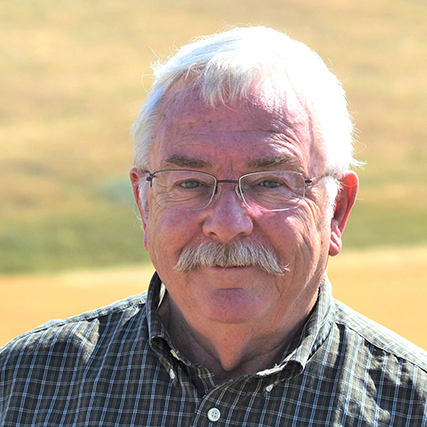
After a career of writing and editing for environmental activism with Montana’s Northern Plains Resource Council, Steve Paulson reconnected with creative writing. His essays have appeared in High Country News, Earth Island Journal, and various newspapers. His poetry in forthcoming in ONE ART: A Journal of Poetry and The Courtship of Winds. He lives near the Yellowstone River.